Why a rooftop costs more
The first time you go up to a Milan rooftop, you notice straight away that the drink costs more than at the bar on the corner. That is not an accident, and it is not only about fashion. A venue at the top of a building carries costs that a street-level bar simply does not have, and those costs end up in the price of everything it serves.
Space and the view
The first cost is space. A terrace on top of a building, a hotel or a tower is expensive, whether it is rented or owned, and it seats fewer people than its floor area suggests: tables have to be spaced out, railings eat into the room, and windows have to be left clear. Square metre for square metre, a rooftop serves fewer guests than an ordinary dining room. The view, which is the reason you are there, is also the reason every seat is worth more.
Access, security and staff
Getting guests to the top means dedicated lifts, controlled entrances and staff to show people up. Many towers have a concierge or security service that the venue pays for. Open-air terraces also need equipment that a normal bar never buys: umbrellas, heaters, covers and furniture that survives wind and sun. None of this shows up as a separate line on the bill, but all of it is in the price.
A short season
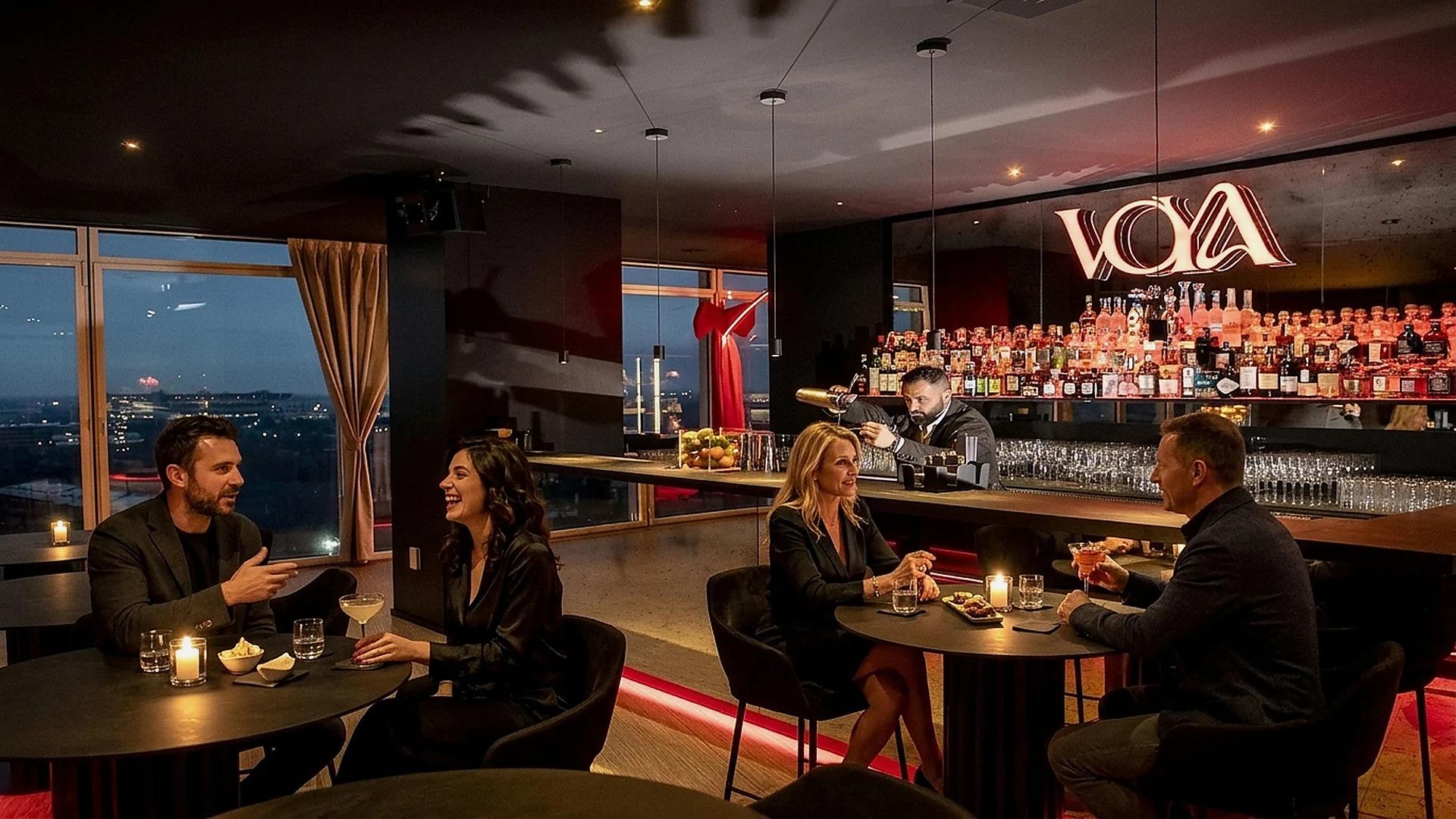
Open-air terraces do most of their business between May and September. In the colder months they close or cut their hours, so they have to earn in five months what an ordinary bar earns in twelve. Rooftops enclosed in glass, such as VOYA Rooftop on the 20th floor of the WJC Tower in Portello, are open all year, but they in turn have higher heating, air conditioning and window maintenance costs than a ground-floor room.
What makes up the price
Whether it is a drink for two or a party for sixty, the price of a rooftop is built from the same elements. Knowing them helps you read a menu or a quote and compare two offers without being misled by the bottom line.
The format of the evening
Drinks cost less than dinner, and a seated dinner costs less than a party with an open bar and a DJ until late. The format decides how many hours you occupy the space, how many staff are needed and how much work the kitchen does. Before you ask for a price, decide what you actually want: a sunset drink, a relaxed dinner or a whole night out. The differences between formats are explained on our pages about the rooftop aperitivo and the rooftop dinner.
Day and time
Friday and Saturday cost more than Tuesday, and sunset costs more than mid-afternoon. In many venues the drinks list stays the same, but the conditions change: a higher minimum spend, a table held only for a set time slot, or bookings accepted only with a set menu. For a group, moving the evening to a weeknight can bring the total down considerably.
Where your table is
Tables along the railing or the windows are the most sought after. Some rooftops give them to whoever books first; others keep them for guests who accept a minimum spend or a set menu. A table in the middle of the terrace may come with lighter conditions. If the view matters more than the budget, ask for a front-row table and find out what it involves.
Drinks
This is the biggest item and the one that gets away from you most easily. A cocktail at the top of a tower costs more than one at street level, and a bottle of wine or sparkling wine at the table can be worth as much as a full dinner. For group quotes, always define the drinks in quantities: how many drinks per person, how many bottles per table, and from which list.
Season
In December, with company dinners and end-of-year parties, prices and minimums go up. On Valentine's Day and New Year's Eve almost every rooftop works with set menus at special prices. In August, by contrast, many venues are more flexible, although some close for the summer holidays.
| Item | When it weighs most | How to keep it under control |
|---|---|---|
| Format | Parties with open bar and DJ | Choose the simplest format you really need |
| Day | Friday, Saturday, December | Consider a weeknight |
| Time | Sunset and early evening | Arrive a little before or after the peak |
| Table | Front row with a view | Ask about conditions before booking |
| Drinks | Bottles at the table, open bar | Fix quantities in writing |
| Season | Holidays and special dates | Book early and compare offers |
Minimum spend, deposit and cover charge
Three terms that come up again and again when you book a rooftop. It is worth understanding them in advance, because they decide what you pay even if you drink very little.
What a minimum spend is
A minimum spend is the amount a group commits to spending in return for a table, an area or the whole venue. If the final bill is lower, you still pay the minimum; if it is higher, you pay the bill. Venues use it mainly on their busiest nights and for groups. It is not an extra charge: it is a guarantee that the table, which could have gone to someone else, will bring in what was expected.
How to read it
A minimum spend only makes sense once you divide it by the number of people. A high minimum for twenty guests may work out at an ordinary round of drinks each; the same minimum for six people becomes an expensive night. Always ask whether the minimum includes service and VAT, whether any order counts towards it or only bottles and menus, and until what time the booking stands.
The deposit
For groups and busy dates, many rooftops ask for a deposit to hold the booking. The deposit is usually deducted from the final bill. Refund terms if you cancel vary from venue to venue: read them before you pay, and for an event make sure they are written into the quote.
Cover charge and service
On rooftops that serve dinner, the cover charge (coperto) is a fixed amount per person shown on the menu, as in any Italian restaurant. In Italy service is included in the prices and tipping is not compulsory. Some high-rise venues, especially in hotels, may add a service charge: if so, it must appear on the menu or in the offer.
What you spend by format
Without inventing figures, which change from venue to venue and year to year, we can describe how spending moves across the different formats. That is the most honest way to prepare.
A drink at sunset
The simplest format: one or two drinks each, often with the plate of nibbles that many bars serve alongside. The bill depends almost entirely on the price of the cocktails, which is higher up a tower than down on the street. To save, a glass of wine or an alcohol-free drink often costs less than a signature cocktail.
An aperitivo for a group
For groups, rooftops usually offer a fixed-price package with a set number of drinks and a selection of finger food. The advantage is that everyone knows in advance what they will spend. When you compare two packages, go line by line: number of drinks, type of food, duration, private area or not.
Dinner
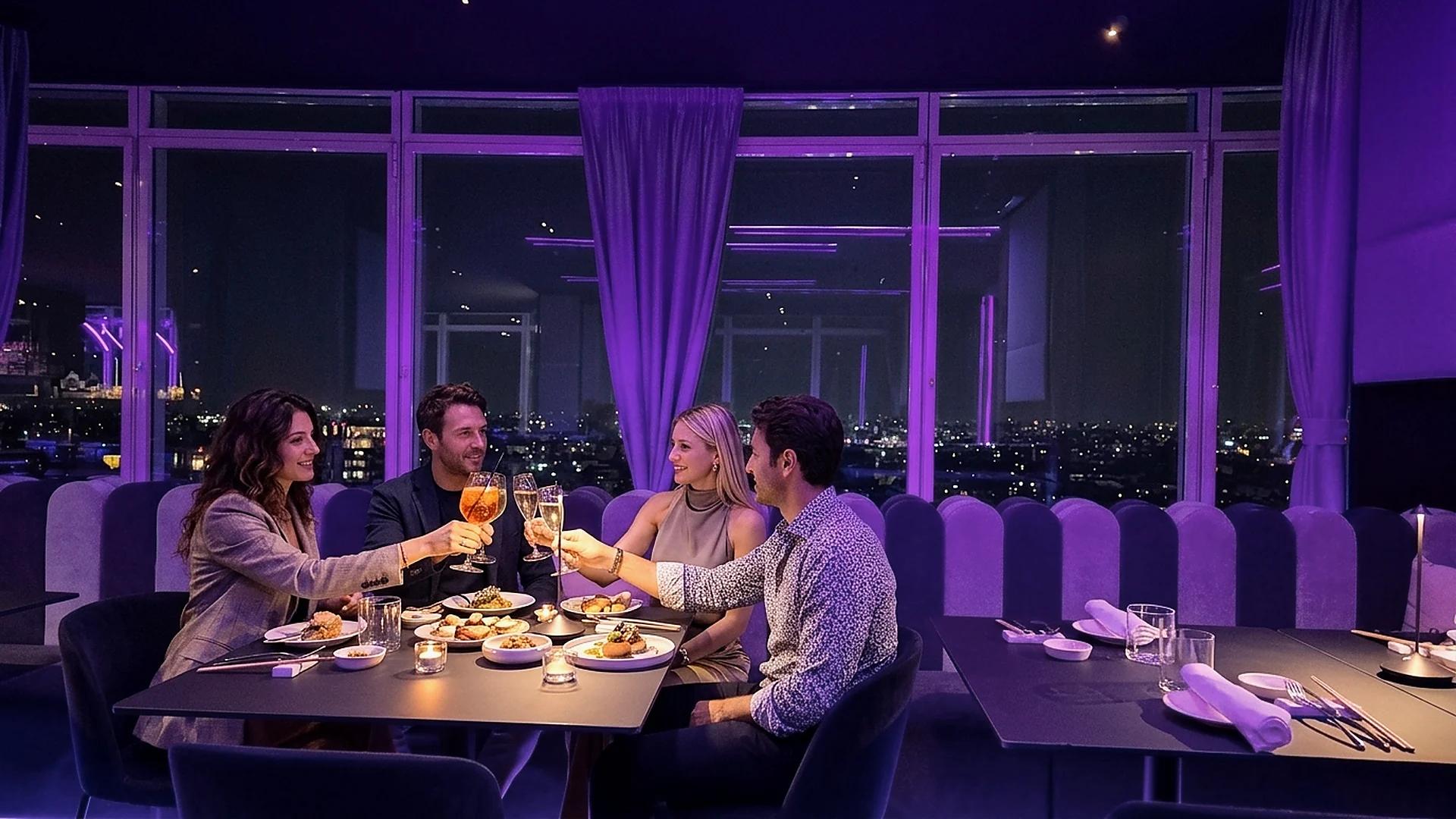
Dinner at the top is priced like a good restaurant, sometimes a little more for the view. For groups, many venues work with set menus of three or four courses. At VOYA Rooftop, for example, group menus have four courses with a choice of meat or fish, and the whole table chooses the same menu. Drinks are the main variable: one bottle of wine for every two guests or one for every four lead to quite different prices per head.
A private party
A private area or exclusive use of the venue for a whole evening is the most expensive format. The price depends on the minimum spend, the menu, whether there is an open bar or a set number of drinks, the music and the finishing time. An event like this needs a written quote, as explained on our page about rooftops for private events.
How to spend less without losing the view
There are practical ways to enjoy a terrace without the bill spoiling the evening.
Pick the right day
A Tuesday or Wednesday evening, especially outside trade fair and fashion weeks, gets you the best tables with no minimum spend or with lighter conditions. For a group, this is the easiest saving of all.
Arrive a little early
Sunset is the most expensive and most crowded hour. Arrive an hour earlier and you will find a table more easily and still see the light change. In some venues the conditions themselves depend on the time.
Choose drinks over dinner
If the view is the main reason, an aperitivo at the top followed by dinner in a restaurant in the neighbourhood costs less than dinner on the terrace and still gives you the city from above at the right moment.
Agree drinks in writing
For a group, a package with a fixed number of drinks avoids the bill that grows glass after glass. Anyone who wants an extra drink pays for it at the bar.
Choose the right season
Glass-enclosed rooftops are cheaper from January to March than in December. Open-air terraces are more flexible at the start and end of the season, in May and September, than in July.
Reading a rooftop quote
When a rooftop sends you an offer for a group or an event, some items should always be there. If they are missing, ask for them.
What to check
The name of the reserved space and whether it is exclusive or shared; arrival and finishing times; the menu or package with the number of drinks; which drinks are included and in what quantities; the music, whether it is the venue's own programme or a dedicated DJ; the minimum spend; the deposit and cancellation terms; the price per person with and without VAT; and the plan B in case of rain for open-air terraces.
Comparing two offers
Two similar prices per head can hide very different evenings. One includes three drinks and a private area, the other a single drink and a shared table. Put the two offers side by side, item by item. In the quotes we prepare, these items are always written in the same order, as described on our page about services for rooftop evenings.
Hidden costs to avoid
Some costs are not really hidden, but you only find out about them at the end if you do not ask beforehand.
Cloakroom
In winter some venues charge for the cloakroom. For a large group it adds up.
Bringing your own cake
Many rooftops charge a service fee per person for a cake brought in from outside. Ask when you book.
Bottles outside the package
At a party, anyone who orders a bottle that is not part of the package pays for it separately. Agree in advance who can order extras and how they are paid for.
Getting home
A rooftop in a tower outside the centre often means a taxi or a car with driver at the end of the night. For a group, that is a cost to plan from the start. For transfers there is our concierge in Milan.