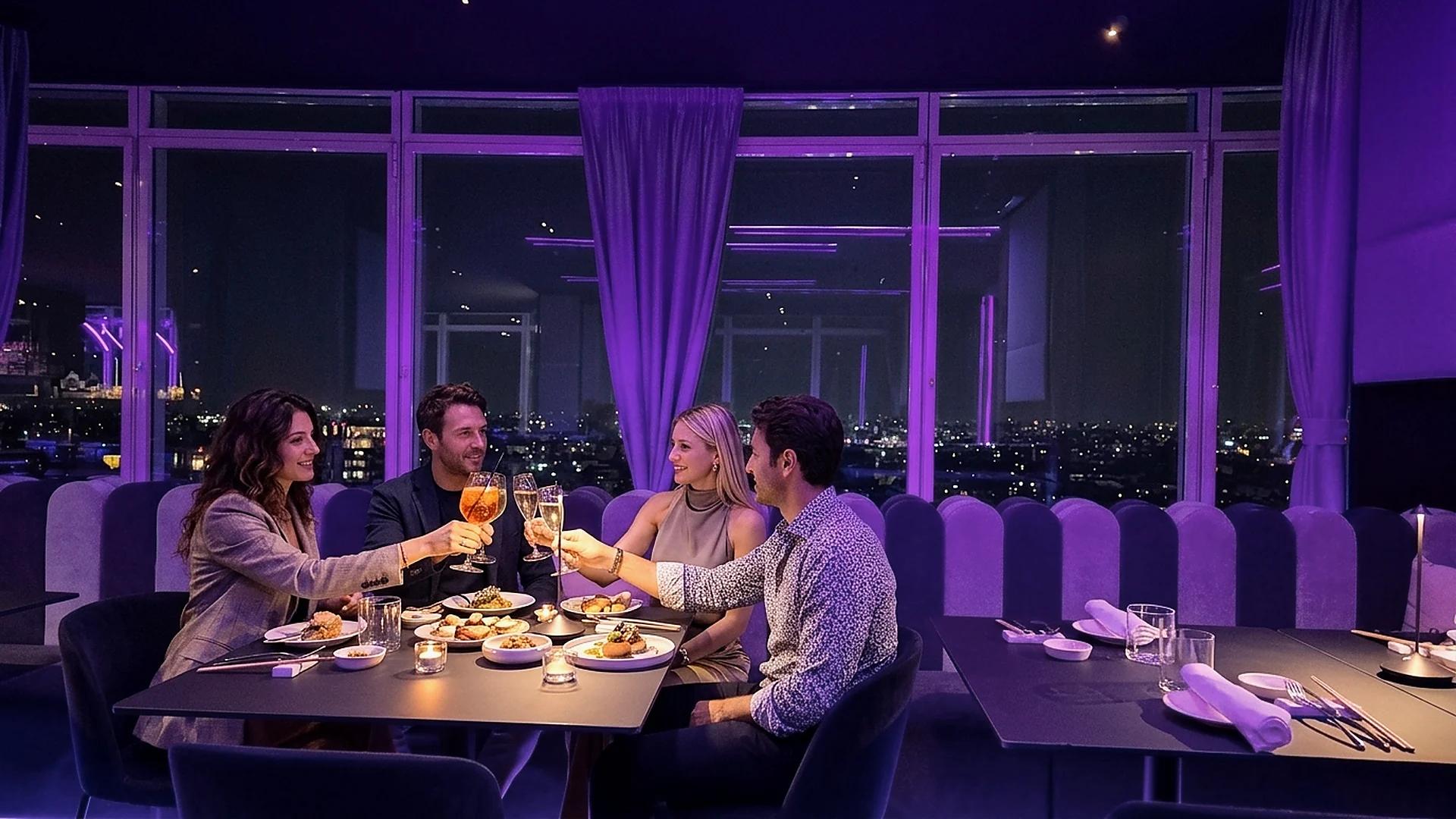
The most requested view in Milan
Almost everyone visiting Milan for the first time wants to see the Duomo from above. The cathedral is the heart of the city, the point from which the main streets fan out, and its silhouette, a forest of white spires topped by the golden Madonnina, is recognisable from just about anywhere. Seeing it from the square is beautiful; seeing it from a terrace, level with the statues, is something else entirely.
What you see
From a terrace in the centre, the view of the Duomo changes a great deal with distance and height. Close up you see the details: the statues, the gargoyles, every single spire. From further away you see the whole cathedral surrounded by the roofs of the old town and, on clear days, the Alps in the background. In the evening the floodlit façade and the shining Madonnina at the top are the main show.
Two ways to get up high
There are two quite different ways of seeing the Duomo from above. The first is to climb the cathedral itself and walk on its roof, which you visit with a ticket. The second is to sit on the terrace of a hotel or building around the square with a drink or dinner. The first is a sightseeing experience, by day; the second is an evening out. Many visitors do both, a few hours apart.
The cathedral's own rooftop
The Duomo's rooftop terraces are the oldest and most famous rooftop in the city, even if nobody serves drinks up there.
What it is
The roof of the cathedral can be walked on: marble walkways run between the spires, pinnacles and statues, up to the highest part near the main spire that carries the Madonnina. From there you can see the whole city, from Castello Sforzesco to the towers of Porta Nuova and CityLife, and the mountains in the distance.
How to get up
You can climb the stairs or take the lift. Tickets are sold through the official channels of the Veneranda Fabbrica del Duomo, the body that has looked after the cathedral since the fourteenth century, and are timed. In high season and at weekends it is worth buying them a few days in advance. In heavy rain, strong wind or during works, access may be restricted.
When to go
The best light is late afternoon, when the low sun warms the marble and the shadows of the spires stretch out. In summer that means going up towards evening; in winter, with sunset coming early, already in the early afternoon. Opening times change with the seasons and should be checked on the official website before you plan your day.
Good to know
The rooftop is part of a place of worship and a monument: dress respectfully, do not run and never climb on balustrades or parapets. There are security checks at the entrance, as for the cathedral itself. For anyone with limited mobility the lift helps, but part of the route is still on foot, on steps and uneven surfaces.
Terraces around the square
For drinks or dinner with a view of the Duomo, you need a terrace on one of the buildings near the cathedral.
Where they are
Around Piazza del Duomo, in the Galleria and in the surrounding streets there are hotels, department stores and historic buildings with terraces and rooms on the top floor. Some face the façade, others the side of the cathedral with its spires. The view varies a lot from one to the next, so ask beforehand: a "Duomo view" can mean looking the Madonnina in the eye or catching a glimpse of a few spires between the roofs.
What they offer
The formats are the same as on any rooftop: aperitivo with drinks and nibbles, dinner à la carte or with a set menu, sometimes brunch at weekends. These spaces are often small, with few front-row tables, and they are among the most requested in the city, by tourists and by Milanese celebrating an occasion. The usual formats are explained on our pages about the rooftop aperitivo and the rooftop dinner.
Covered or open
Some terraces in the centre are open-air and work mainly from spring to autumn; others have a roof or a glass-enclosed room. For an evening between November and March, always ask where you will be seated: an inside room with small windows is not the same as a terrace facing the spires.
| Experience | When | What you see | How to book |
|---|---|---|---|
| Cathedral rooftop | Daytime, seasonal hours | Spires and statues up close, the whole city | Timed ticket through official channels |
| Aperitivo terrace | Afternoon and evening | Façade or side of the Duomo | Table booked with the venue |
| Dinner terrace | Evening | Floodlit Duomo and Madonnina | Booking, often well ahead |
The best times
The same terrace offers a different show depending on the hour.
Late afternoon
The Candoglia marble the Duomo is built from has pink veins that show best in the low afternoon light. It is the best time for photographs and for seeing the detail of the spires.
Sunset
The sky changes colour behind the cathedral and the façade warms up. It is the most requested hour, so a front-row table needs a booking. In summer the sun sets around nine in the evening, in winter before five in the afternoon.
Evening
After dark the façade lighting comes on and the Madonnina glows at the top of the main spire. It is the time for dinner and a last drink, and on many terraces it is quieter than sunset.
The Duomo in a few lines
Knowing what you are looking at makes the view even better. Here is the cathedral's story in brief, handy for telling guests who come from abroad.
Six centuries of building work
Construction of the Duomo began in 1386 at the wish of Gian Galeazzo Visconti, lord of Milan, and went on for centuries. The marble came from the Candoglia quarries near Lake Maggiore and reached the city by water, along the Navigli canals, to a small basin near today's Via Laghetto. The façade was only completed in the early nineteenth century, in the Napoleonic era, and finishing and restoration work has never really stopped: the Veneranda Fabbrica still maintains the spires and statues today.
The Madonnina
The highest spire carries the Madonnina, the gilded statue of the Virgin placed there in 1774, which became the symbol of the city, so much so that a well-known Milanese song celebrates her as Milan's protector. For a long time an unwritten rule said that no building should rise above her. When the Pirelli skyscraper did, a copy of the statue was placed on its roof, and later towers have kept up the same tradition. Symbolically, the Madonnina always remains the highest point of the city.
Spires and statues
The Duomo has more than a hundred spires and thousands of statues on its façades, pinnacles and terraces. From the rooftop you can see up close saints, prophets, fantastic animals and gargoyles; some have been replaced over time with copies, while the originals are kept in the Museo del Duomo next to Palazzo Reale.
Photographing the Duomo from above
A terrace facing the Duomo is also one of the best places to photograph Milan. A few practical tips help you take home the right picture.
The light
The Duomo's façade faces west. Afternoon sun lights it fully and brings out the rosy colour of the marble; in the morning the façade is in shade and the best light falls on the side and the apse. At sunset the sky behind the spires turns orange and violet, and a few minutes later the floodlights come on: this is the so-called blue hour, when sky and lights are in balance.
Your phone
A modern phone takes excellent pictures even at night, as long as you keep it still by resting it on the table or the parapet without leaning out. The glass of enclosed terraces reflects the lights of the room: bringing the lens close to the glass and shading the reflections with your hand helps a lot.
Respect for others
On a full terrace, getting up every few minutes to take pictures disturbs the people next to you. Take your shots when you arrive, before you sit down, and then enjoy the view.
Planning the evening
A day around the Duomo
A plan that works well for visitors: the cathedral rooftop in the afternoon, a walk through the Galleria Vittorio Emanuele II, an aperitivo on a terrace with a view at sunset, then dinner in the centre or in Brera. All of it on foot, no transport needed.
Booking
Terraces facing the Duomo are among the smallest and most requested. For Friday and Saturday, and during trade fair and fashion weeks, it is worth booking several days ahead and saying that you would like a table facing the cathedral. It cannot always be guaranteed: when it cannot, it is better to know beforehand.
Groups
For a large group, terraces in the centre are often too small. You can have an aperitivo in the centre with a smaller group and then move on for dinner, or choose a bigger terrace elsewhere in the city. For parties and private events at the top there is our page about rooftops for private events.
Getting there and around
Metro
Piazza del Duomo is served by the red M1 and yellow M3 lines, with the Duomo stop right under the square. It is the easiest way to get there, especially in the evening.
Car and Area C
Central Milan lies inside Area C, the restricted traffic zone where many vehicles pay to enter on weekdays. Street parking is almost impossible. If you come by car, use a car park on the edge of the centre and then the metro, or take a taxi.
On foot
From the Duomo you can walk to Brera, La Scala, Castello Sforzesco and the fashion district. An evening in the centre can be organised entirely on foot.
Alternatives to the Duomo view
Not every Milan rooftop looks at the Duomo, and some of the finest offer another panorama.
The modern skyline
From Porta Nuova and Isola you see the newest towers and the Bosco Verticale. From CityLife and Portello you see the three towers and the whole city through 360 degrees, as from VOYA Rooftop on the 20th floor of the WJC Tower. These are different, more contemporary views, often from larger and quieter spaces than those in the centre.
The Duomo from a distance
From many high-rise terraces the Duomo appears in the distance, small but recognisable among the roofs. If you want the cathedral as part of a wider panorama, this gives you everything at once. For an overview of the areas there is our page on rooftops in Milan.